Northern Ireland vs Ireland
Ask ten people in a Monaghan pub where Ireland stops and Northern Ireland starts and you will get eleven answers. The facts, thankfully, are simpler than the arguments. There is one island and two jurisdictions. The Republic of Ireland is an independent country. Northern Ireland is part of the United Kingdom. Between them runs a line on the map that you will cross in the car without a barrier, a checkpoint or, most of the time, so much as a sign.
And still, things change. Your phone may pick up a different network. The speed limit signs swap units. The euro in your pocket gets a funny look in the café. This guide takes the differences between Northern Ireland and Ireland in the order you will actually run into them, with tables you can screenshot and an FAQ at the end for the questions people really type into Google.
| The short answer: Ireland (the Republic) is a sovereign country and an EU member. It uses the euro and has 26 counties. Northern Ireland is one of the four nations of the United Kingdom. It uses the pound sterling and has 6 counties. Both sit on the same island, both drive on the left, and English is the everyday language in both. |
First, the Name Problem
Part of the confusion is down to the word itself. “Ireland” means the island, and it also means the state that covers most of it. The island holds 32 counties. Twenty-six belong to the Republic and six belong to Northern Ireland: Antrim, Armagh, Down, Fermanagh, Derry and Tyrone.
Then there is Ulster, which trips up even Irish people. Ulster is one of the four historic provinces and it has nine counties. Six are in Northern Ireland. The other three, Donegal, Cavan and Monaghan, are in the Republic. So “Ulster” and “Northern Ireland” are not the same thing. The lovely drive over the Glengesh Pass in Donegal is a good example: it is deep in Ulster, and entirely in the Republic.
In everyday talk you will hear “the North” and “the South”, and nobody minds. “Southern Ireland” and “Eire” sound dated, so it is best to say “the Republic” or just “Ireland”.
Northern Ireland vs Ireland at a Glance
| Feature | Ireland (Republic) | Northern Ireland |
| Status | Independent sovereign state | Part of the United Kingdom |
| Capital | Dublin | Belfast |
| Head of state | An elected President | The monarch (King) |
| Parliament | Oireachtas (Dáil and Seanad) at Leinster House | Northern Ireland Assembly at Stormont, plus MPs at Westminster |
| Currency | Euro (EUR) | Pound sterling (GBP) |
| Counties | 26 | 6 |
| Population | Just over 5 million | Around 1.9 million |
| Area | About 70,000 square km | About 14,000 square km |
| Languages | Irish (first official) and English | English; Irish and Ulster Scots have official recognition |
| Road speed signs | Kilometres per hour | Miles per hour |
| Police | An Garda Síochána (mostly unarmed) | Police Service of Northern Ireland (armed officers) |
| Emergency number | 112 or 999 | 999 or 112 |
| Phone code | +353 | +44 |
| Postcodes | Eircode (for example D02 XR20) | UK postcodes starting BT |
| Plug type | Type G | Type G |
| Driving side | Left | Left |
1. Two Governments, Two Flags
The Republic is a parliamentary republic. The Taoiseach, the head of government, runs the country day to day, while the President, elected directly by the people, holds a mostly ceremonial role. Laws are made at Leinster House in Dublin.
Northern Ireland works differently. It has had its own devolved Assembly at Stormont since the Good Friday Agreement of 1998, where unionist and nationalist parties share power by design. But the big levers, such as defence and foreign policy, stay with the UK government in London, and Northern Ireland elects MPs to Westminster as well. The head of state is the British monarch.
Flags matter here more than visitors expect. The tricolour and the Union flag are not just decoration in some neighbourhoods. Enjoy the murals, take photos respectfully, and don’t wave either one around to be funny.
2. Euro or Sterling
This is the difference that hits your wallet first. Ireland uses the euro. Northern Ireland uses the pound, like the rest of the UK. Cards and contactless work on both sides, so you rarely need much cash, but a few notes in the right currency save a lot of faffing at small cafés, car parks and farm shops.
There is a quirk worth knowing. Several Northern Irish banks print their own sterling notes. They are legal tender in the sense that matters to you, but a shop in England can be sniffy about taking them. Spend them before you fly out of Belfast. Near the border, some shops and petrol stations will take euro or sterling, but the exchange rate on the shop floor is rarely kind. Pay by card and let your bank do the sums.
3. Driving, Signs and Speed
Good news first: both sides drive on the left, and fuel is sold in litres on both. The catch is the speed signs. In the Republic a limit sign reads in kilometres per hour, so an 80 on a country road means 80 km/h, around 50 mph. In Northern Ireland the same road might carry a 60 mph limit, shown as a plain number or as the white circle with a black diagonal stripe. Distance signs follow the same split: kilometres in the Republic, miles in the North.
The signs themselves look different. In the Republic they are bilingual, with English place names in capitals and Irish names in a slanted style. In Northern Ireland they are English only, in the same format as signs in Britain. The moment the road signs go from bilingual to English-only, you are across.
Hire cars are the real trap. Some rental companies charge a cross-border fee or ask you to tell them first, and your insurance may not cover you if you don’t. Read the small print before you book, not at the desk. If you are planning a longer drive, our guide to the Glengesh Pass in Donegal covers narrow-road manners that apply on both sides of the line.
4. Language and Place Names
In the Republic, Irish is the first official language and English the second. Irish is spoken as the daily language in the Gaeltacht areas, mostly along the western seaboard, and every child learns it at school. Head west into Connemara and you will hear it in shops and on the radio. The Connemara Giant in Recess sits in exactly that sort of country, and it is a fun stop if you want to see where the language and the landscape still go hand in hand.
In Northern Ireland, English is the working language, but a law passed a few years ago gave Irish and Ulster Scots official recognition, and you will now spot more Irish on signs, in public bodies and in Belfast’s Gaeltacht Quarter. It is a live political topic, so listen more than you talk.
One small tip on names. The second city of Northern Ireland is called both Derry and Londonderry. Locals mostly say Derry, and you will see either on signs. Say Derry in conversation and you will rarely go wrong.
5. Policing and Law
In the Republic you will deal with An Garda Síochána, who are mostly unarmed in day-to-day work. In Northern Ireland the force is the Police Service of Northern Ireland, known as the PSNI, and its officers carry firearms as a matter of routine. Seeing that for the first time can be a jolt, but it is normal there and nothing to worry about.
The two places also have separate legal systems. Northern Ireland is part of the UK, yet it has its own courts and its own laws, distinct from those in England, Scotland and Wales. For a visitor the key point is easy: ring 999 or 112 and you will get help on either side of the border.
6. The Economy in Numbers
Two economies share the island, and the gap shows up in the data. A cross-border comparison from the Economic and Social Research Institute found that Northern Ireland has a larger public sector share of employment, while the Republic has a bigger slice of jobs in tech and financial services. Income tax collected per head is more than twice as high in the Republic, and the study also found that far more teenagers aged 15 to 19 stay in education there.
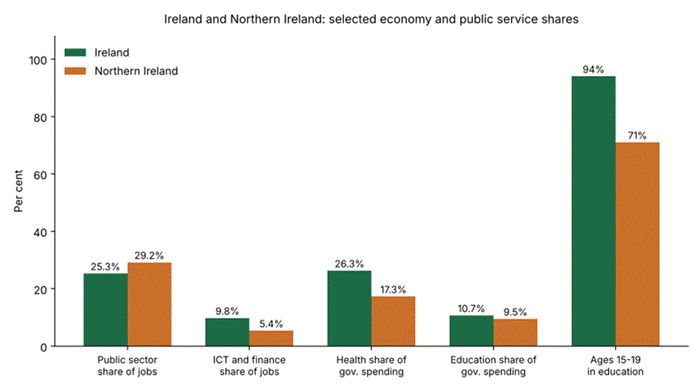
Figure 1: Selected shares for Ireland and Northern Ireland. Source: ESRI cross-border economic comparison.
None of this makes one place better than the other. It explains why wages, rents and prices feel different when you move between them. Dublin hotel rooms can cost a lot more than similar ones in Belfast, but rural stays in the Republic can match or beat northern prices. Always compare the final price, not the headline number.
7. Sport on One Island
Sport is where the island acts as one and splits in two, sometimes on the same weekend. Rugby is organised on an all-Ireland basis, so players from Belfast and Cork wear the same shirt. The GAA runs Gaelic games across all 32 counties. Cricket and hockey also work on an island-wide basis.
Football is the exception. The Republic has the FAI and its own national team, while Northern Ireland has the IFA and a separate one. At the Olympics, athletes born in Northern Ireland can choose to represent either Ireland or Great Britain and Northern Ireland, a small reminder of how mixed the identities are.
8. Everyday Life: Shops, Holidays and Accents
- Sunday shopping: large shops in Northern Ireland follow UK trading rules and open for a shorter window on Sundays, roughly 1pm to 6pm. The Republic has no such limit.
- Bank holidays: St Patrick’s Day is a public holiday on both sides. The 12th of July is a bank holiday only in Northern Ireland.
- Accents: a Belfast voice, a Dublin voice and a Cork voice are miles apart. Northern accents tend to sound harder and quicker to southern ears, and the other way round.
- Mobile phones: near the border, your phone may latch onto the other country’s network. That can trigger roaming charges, so check your plan or switch off automatic network selection.
- Postcodes and phone codes: Ireland uses Eircodes and +353. Northern Ireland uses BT postcodes and +44.
Crossing the Border: A Practical Checklist
- ID: there are no routine checks on the road, but carry your passport or photo ID anyway, especially if you are flying in or out.
- Entry rules: Irish and British citizens move freely under the Common Travel Area. Visitors from elsewhere should check the rules for each place. Being allowed into one does not always mean the other. Start with the UK ETA page and Irish Immigration.
- Money: carry a little of each currency, and use a card for anything big.
- Car hire: confirm cross-border cover in writing.
- Insurance: make sure your travel insurance covers both jurisdictions.
- Plugs: both use Type G, so one adaptor does the job.
A Short Word on How We Got Here
The line on the map dates from the early 1920s. After the War of Independence, the Partition of Ireland created Northern Ireland as a separate state inside the UK, and the rest of the island became the Irish Free State, which later became the Republic. Decades of conflict known as the Troubles followed, mostly in the North, and ended in practical terms with the Good Friday Agreement in 1998.
Whether the island should ever become one state is a live question, and I will leave that one to the voters. What matters for a traveller is that peace is real, daily life is calm, and the people on both sides are, in my experience, among the friendliest you will meet anywhere.
Visitor Scorecard: How the Two Compare
Here is my own take, out of five. It is opinion, not statistics, so argue with it as much as you like.
| Category | Ireland | Northern Ireland | Why |
| Scenery and variety | 5 / 5 | 4 / 5 | The Republic is five times bigger and has Kerry, Clare and the Atlantic coast. The North packs in the Causeway Coast and the Mournes. |
| Easy to cover in 3 days | 3 / 5 | 5 / 5 | Northern Ireland is compact. You can see its best in a long weekend. |
| Capital city break | 4 / 5 | 4 / 5 | Dublin has the buzz. Belfast has the stories and the food scene. |
| Traditional music sessions | 5 / 5 | 4 / 5 | Sessions are everywhere in the west of the Republic. |
| Recent history | 4 / 5 | 5 / 5 | Belfast and Derry make the 20th century feel close. |
| Value for money | 3 / 5 | 4 / 5 | Often better in the North, though exchange rates and season change this. |
| Public transport outside cities | 3 / 5 | 3 / 5 | A car helps on both sides. |
Places That Show the Difference
| Place | Address | What it shows |
| Leinster House | Kildare Street, Dublin 2, D02 XR20 | Where the Irish parliament sits |
| Áras an Uachtaráin | Phoenix Park, Dublin 8 | The home of the President of Ireland |
| Dublin Castle | Dame Street, Dublin 2 | Centuries of rule and the road to independence |
| Parliament Buildings, Stormont | Upper Newtownards Road, Belfast BT4 3XX | The Northern Ireland Assembly |
| Belfast City Hall | Donegall Square North, Belfast BT1 5GS | The civic heart of Northern Ireland |
| Titanic Belfast | 1 Olympic Way, Queen’s Road, Belfast BT3 9EP | Industrial Belfast, told well |
| Glengesh Pass | R230, between Ardara and Glencolmcille, Co. Donegal | Ulster scenery inside the Republic; see our Glengesh Pass guide |
So Which One Should You Visit?
Both. Dublin to Belfast is roughly two hours by car or train, so the real question is how you split your days. If you have three or four, base yourself in Belfast and see the Causeway Coast and the Glens. With a week or more, add the Republic’s west: Galway, Connemara and Donegal. The Connemara Giant and the Glengesh Pass make good anchors for that side.
The Bottom Line
Northern Ireland and Ireland share a landscape, a sense of humour and a love of a good chat, but they are different places with different governments, money and rules. Know the basics, keep both currencies handy, mind the speed signs, and you will cross the line without noticing. Then enjoy the island for what it is: small, wet, and very hard to leave.
Frequently Asked Questions
Is Northern Ireland part of Ireland?
Geographically yes, because Northern Ireland sits on the island of Ireland. Politically no. It is part of the United Kingdom, while the Republic of Ireland is a separate sovereign state.
Is Ireland part of the UK?
No. The Republic of Ireland left the United Kingdom in the early 1920s and is an independent country and a member of the European Union. Only Northern Ireland remains in the UK.
Do I need a passport to go from Ireland to Northern Ireland?
There are no routine border checks, so you will not be stopped on the road. Still, carry ID, because airlines, hotels and car hire firms ask for it. Visitors who need a visa or an electronic authorisation should check both the UK ETA page and Irish Immigration, as rules differ. Citizens of Ireland and the UK have special rights under the Common Travel Area.
What currency does Northern Ireland use?
The pound sterling. The Republic uses the euro. Card payments are accepted almost everywhere, though some border shops will take either currency at their own rate.
Is Dublin in Northern Ireland?
No. Dublin is the capital of the Republic of Ireland. The capital of Northern Ireland is Belfast, home to the Assembly at Stormont.
Do they drive on the same side of the road?
Yes, the left. The difference is the units: kilometres per hour in the Republic and miles per hour in Northern Ireland.
Can I use my phone in both places?
Usually, but roaming rules vary by provider and plan. Near the border, a phone can jump to the other country’s network, so check your charges in advance.
Is Northern Ireland safe to visit?
Yes. The Troubles ended with the Good Friday Agreement, and visitors enjoy a calm, welcoming place. Use ordinary common sense, avoid political marches and follow local news, as you would anywhere.
Which has the better police presence for visitors?
Both are helpful. You will meet the Garda Síochána in the Republic and the PSNI in the North. Dial 999 or 112 in an emergency anywhere on the island.
Is it cheaper to visit Northern Ireland or Ireland?
There is no flat answer. Dublin and the west in summer can be costly, and Belfast hotels spike on event weekends. Compare the total price for your dates, and watch the exchange rate between euro and sterling.
Related Posts
- Glengesh Pass in Donegal: Viewpoint, Parking and How to Drive It
- The Connemara Giant: Modern Irish Mythology in Recess, Co. Galway
Disclaimer
This article is for general information and travel planning only. Rules on entry, visas, driving, insurance, currency and opening hours change, so check official sources before you travel. Nothing here is legal, immigration or financial advice. The scorecard reflects the author’s opinion. Links to outside websites are provided for convenience, and Dreaming Ireland is not responsible for their content.